
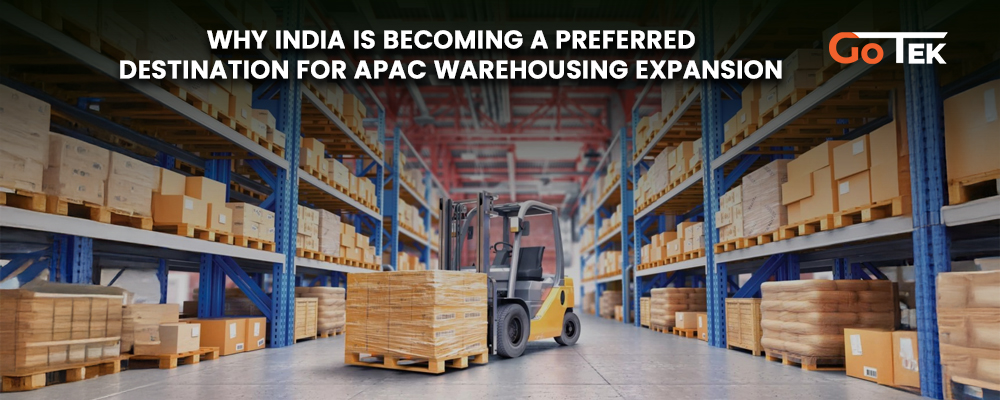
Introduction: A Transformational Era for Warehousing in Asia
Over the past decade, the global supply chain landscape has undergone a seismic shift. With rising consumer demand, disruptions in traditional distribution hubs, and intensifying focus on operational resilience, companies across the Asia-Pacific (APAC) region are evaluating alternative locations to support their logistics infrastructure. Among these, India has emerged as one of the most attractive and rapidly expanding destinations for warehousing and storage solutions a trend visible across industries ranging from e-commerce and retail to manufacturing and FMCG.
This blog explores why India is becoming a preferred destination for APAC warehousing expansion, the key forces driving this momentum, and how brands like GoTEK Logistics exemplify the country’s capability as the Best warehousing service provider in India.
The Changing Dynamics of APAC Supply Chains
Historically, many APAC supply chains were concentrated in China and Southeast Asia, benefiting from well-developed infrastructure and proximity to manufacturing hubs. However, the post-pandemic resurgence, geopolitical shifts, and strategic diversifications have encouraged firms to explore alternative bases to reduce dependency and enhance supply chain resilience.
According to the 2025 India Logistics Occupier Survey by CBRE, nearly 70% of APAC occupiers prefer to expand their warehousing footprint in India over the next two years. This reflects a broader confidence in India’s logistics potential and a clear shift toward a diversified regional presence.
The reasons for this shift are not incidental they stem from structural changes in India’s economy, policy reforms, infrastructure investment, and the strategic role of warehousing in accomplishing business objectives.
Strong Economic Growth: Fueling Demand for Logistics
India’s GDP growth remains one of the strongest among emerging markets, underpinning significant demand for logistics services. Consumer spending is rising, e-commerce penetration continues to accelerate, and sectors such as automotive and manufacturing are investing heavily in distribution networks. This growth naturally cascades into the warehousing segment, making storage and stock management an indispensable component of supply chain planning.
With increased economic activity, companies are realising that a robust warehousing partner is not a cost centre but a strategic asset that enhances speed, reliability, and adaptability to market demands, especially for cross-border or regional distribution needs.
Regulatory and Policy Reforms: Enabling Logistics Scalability
A key factor propelling India’s logistics evolution has been government support. Initiatives like the National Logistics Policy, GST implementation, and flagship infrastructure projects have significantly improved the logistics environment. These reforms have:
- Unified tax structures facilitate seamless interstate movement.
- Encouraged formalisation of warehousing through regulation and accreditation (e.g., WDRA standards).
- Advanced multimodal logistics to reduce freight costs and transportation time.
The reduction in red tape and improved operating clarity have made India a competitive alternative for warehousing investment relative to traditional APAC locations.
Infrastructure Development: Connecting Warehouses to Markets
One of India’s most compelling advantages in the logistics race is its expanding network of transport infrastructure. Major highways, rail freight corridors, and logistics parks are transforming warehousing connectivity across the country.
Strategically located hubs in Delhi NCR, Mumbai, Bengaluru, and Chennai are already established as logistics powerhouses, while emerging markets in Tier II and Tier III cities are rapidly gaining traction as demand centres grow. This diversification aligns with companies’ intent to shorten delivery lead times and optimise last-mile distribution.
India’s geography also serves as a natural crossroads for trade routes linking South Asia with the Middle East, Africa, and Southeast Asia, further reinforcing its appeal to APAC logistics planners who seek a central node that enhances multiregional access.
Technology Adoption: Smart Warehouses for the Future
Warehousing is no longer merely a space to store goods it is the heartbeat of efficient supply chains. To stay competitive, Indian logistics providers have embraced technology to improve precision, speed, and inventory control.
Modern warehouses leverage Warehouse Management Systems (WMS), Automation, Internet of Things (IoT), and predictive analytics. These technologies enhance visibility, reduce errors, and support just-in-time performance, a capability that multinational firms value when expanding within APAC.
This advancement ensures that India’s warehouses are not only large in scale but also intelligent, capable of supporting high throughput with operational efficiency akin to global standards.
Rising Third-Party Logistics (3PL) Adoption
Third-party logistics providers are at the forefront of India’s warehousing boom. With APAC occupiers increasingly outsourcing logistics functions, 3PL service providers in India are scaling rapidly to meet diverse demands ranging from e-commerce fulfilment to cold chain logistics. Companies like GoTEK are playing a critical role by offering flexible, technology-driven warehousing and distribution solutions that support fast-growing businesses across industries.
Between 2021 and 2025, 3PL companies accounted for a significant share of big-box warehouse leasing, exemplifying the shift toward scalable and cost-efficient warehousing infrastructure. This growth highlights how 3PL service providers in India are enabling businesses to optimise supply chains without heavy capital investment.
India’s 3PL ecosystem is attracting global attention as firms seek to reduce capital costs, improve service levels, and leverage the expertise of reliable logistics partners such as GoTEK, a trusted name in integrated logistics and warehousing solutions.
Regional Diversity & Cost Advantage
India’s warehousing landscape is increasingly diversified across regions, which is important for companies looking to balance cost and service quality:
- Western India (Mumbai, Pune) caters to exports and commercial demand.
- Northern India (Delhi NCR) offers excellent connectivity and population density.
- Southern and eastern hubs (Bengaluru, Chennai, Kolkata) support manufacturing and distribution.
This regional breadth allows businesses to strategically position warehouses to align with market demand, balancing cost-to-serve and delivery speed.
Moreover, despite rising real estate prices in tier-I cities, India still provides a cost-efficient landscape for warehousing investment when compared to mature logistics markets.
Challenges and Mitigating Factors
While India’s logistics outlook is positive, challenges remain:
- Operational costs: Logistics expenses account for a notable share of GDP, driven by land, labor, and utilities.
- Regulatory complexity: Though improving, compliance can still vary across states.
- Infrastructure gaps: Some rural or nascent regions may lack advanced connectivity.
However, these challenges are being addressed through continued investment, public-private partnerships, and technological modernization that collectively strengthen India as an APAC warehousing destination.
The Role of Trusted Logistics Partners
During this evolution, businesses need a logistics partner that can turn market complexity into operational advantage, covering everything from intelligent storage design and regulatory compliance to distribution and Value Added Services in Supply Chain Management. These services help streamline operations, reduce costs, and improve speed-to-market for growing enterprises.
This is where GoTEK Logistics makes a measurable difference. With scalable solutions, advanced infrastructure, and a customer-first approach, GoTEK empowers businesses to optimise their supply chains and stay competitive. Partner with GoTEK today to unlock smarter, faster, and more efficient supply chain performance.
Spotlight: GoTEK Logistics Redefining Warehousing Excellence
As India’s logistics landscape continues to evolve, GoTEK Logistics has emerged as a leader among service providers delivering comprehensive warehousing and supply chain solutions. With a vision centered on precision, transparency, and customer–first solutions, GoTEK underscores why selecting the warehousing service provider in India can be a game-changer for APAC expansion strategies.
What Makes GoTEK Logistics Stand Out?
1. Comprehensive Warehousing & Storage Solutions
GoTEK offers a broad array of warehouse configurations, including dedicated and multi-user facilities, palletised and non-palletised storage, and conditions ranging from ambient to temperature-controlled environments, catering to diverse goods and industry requirements.
Whether you’re storing industrial materials, e-commerce inventory, or temperature-sensitive products, GoTEK’s facilities ensure operational efficiency and asset safety through advanced infrastructure and expert management.
With its warehousing expertise, GoTEK continues to be recognised as one of the Top warehousing service providers in India, setting benchmarks for quality and reliability in logistics operations.
(Explore more about GoTEK’s solutions here: Best warehousing service provider in India)
2. End-to-End Supply Chain Integration
Beyond storage, GoTEK integrates warehousing with distribution, transportation, and value-added services such as pick & pack, sequencing, JIT support, and returns management. This holistic model reduces complexity for clients and enhances supply chain visibility, an invaluable advantage when operating across APAC markets.
3. Technology and Transparency
GoTEK’s adoption of GPS-enabled fleets, WMS, and digital tracking tools brings enhanced operational transparency, empowering customers with real-time insights into their inventory movements and enabling smarter decision-making.
4. Pan-India Reach and Flexibility
With a network strategically positioned across major industrial and consumption hubs, GoTEK offers accelerated reach to markets nationwide. This nationwide footprint supports agile distribution, allowing companies to adapt to regional demand shifts and optimise logistics spend.
5. Client-Centric, Scalable Operations
GoTEK’s team of experts designs flexible warehousing solutions that adapt to seasonal demand, market fluctuations, and business growth, a feature especially beneficial for APAC businesses scaling their operations from India outward.
In essence, GoTEK Logistics not only provides warehousing space; it delivers an ecosystem where logistics performance fuels business growth.
To recap, the factors that make India a strategic choice for warehousing expansion in the APAC region include:
✔ Strategic Geographical Position
India’s central location aligns with key trade routes across Asia, the Middle East, and Africa, offering logistical advantages for companies seeking regional connectivity.
✔ E-commerce and Retail Surge
India’s booming online retail market significantly contributes to warehousing demand, necessitating efficient and scalable storage solutions.
✔ Infrastructure Improvements
Projects like dedicated freight corridors and logistics parks are enhancing connectivity and reducing cost barriers.
✔ Government Support
Reform-oriented policies make logistics operations more predictable and scalable.
✔ Tech-Driven Modern Warehouses
Automation, smart systems, and digital processes elevate India’s warehousing standards globally.
✔ Versatile 3PL Ecosystem
CPaaS (contract logistics) models, flexible leasing
Conclusion: India’s Ascendancy in the APAC Warehousing Map
India’s ascent as a preferred destination for warehousing expansion in the APAC region is not accidental it is the result of coordinated economic growth, policy support, infrastructure planning, and technological leapfrogging.
Logistics and warehousing are now at the heart of this transformation, with companies seeking operational resilience, cost optimisation, and flexible distribution networks goals that India’s market and service providers are increasingly capable of delivering.
Partnering with strategic logistics firms such as GoTEK Logistics helps businesses navigate this dynamic environment with confidence, enabling them to tap into India’s massive potential for storage, efficiency, and regional connectivity.
As more enterprises plot their APAC expansion roadmaps, India’s warehousing ecosystem is set to become a cornerstone of supply chain strategy and logistics partners who can deliver scale, technology, and reliability will define success in this new era.
People also ask
1. Why is India becoming a preferred destination for APAC warehousing expansion?
India offers strong economic growth, policy reforms, modern infrastructure, cost advantages, and a scalable 3PL ecosystem, making it an ideal hub for resilient and diversified APAC warehousing strategies.
2. How has India’s economic growth impacted the warehousing sector?
Rising GDP, increased consumer demand, e-commerce growth, and manufacturing expansion have driven higher demand for warehousing, positioning storage as a strategic asset rather than just a cost centre.
3. What role do government policies play in India’s logistics growth?
Policies like GST, the National Logistics Policy, and infrastructure initiatives have simplified interstate movement, improved compliance, reduced costs, and enabled scalable logistics and warehousing operations.
4. How does infrastructure development support warehousing in India?
Dedicated freight corridors, highways, rail networks, and logistics parks connect warehouses to major markets, reducing lead times and improving last-mile distribution across Tier I, II, and III cities.
5.Why are APAC companies increasing their reliance on 3PL service providers in India?
3PL service providers in India offer flexible, technology-driven warehousing, cost efficiency, and scalability, allowing businesses to optimise supply chains without heavy capital investment.
6. How is technology transforming Indian warehouses?
Indian warehouses use WMS, IoT, automation, and analytics to improve inventory visibility, accuracy, and speed, enabling global-standard operations and supporting just-in-time supply chain models.
7. What cost advantages does India offer for warehousing investment?
Compared to mature APAC markets, India offers lower operational and real estate costs while maintaining service quality, especially when warehouses are strategically located across diverse regions.
8. What challenges exist in India’s logistics sector?
Challenges include operational costs, regulatory variations, and infrastructure gaps in some regions, but ongoing investments, technology adoption, and policy reforms are steadily addressing these issues.
9. What are Value Added Services in Supply Chain Management?
Value Added Services in supply chain management include pick and pack, labeling, sequencing, JIT support, and returns management, helping businesses reduce costs and improve speed-to-market.
10. Why is GoTEK Logistics considered a leading warehousing partner in India?
GoTEK Logistics offers integrated warehousing, pan-India reach, advanced technology, value-added services, and scalable solutions, making it a trusted partner for APAC warehousing expansion.
11. What is the full form of APAC in logistics?
APAC stands for Asia-Pacific. In logistics, APAC refers to the Asia-Pacific region, covering countries across East Asia, South Asia, Southeast Asia, and Oceania, and represents a major hub for global trade, manufacturing, and supply chain operations.